



Read this article in 中文 Français Deutsch Italiano Português Español
Aecom pairs with energy firms to pursue UK’s first nuclear fusion plant

Partner Content produced by KHL Content Studio
06 May 2026
Engineering company Aecom has announced a partnership with two energy companies to pursue the development of the first private-sector-led nuclear fusion power plant project in the UK.
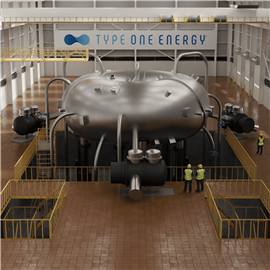 A digital render of Type One Energy’s fusion stellerator plant (Image: Type One Energy)
Working alongside Tokamak Energy and Type One Energy, as part of the UK Infinity Fusion Consortium, the companies said they wanted to develop a “commercially credible” fusion project that can be deployed using existing technologies.
The project also hopes to attract private capital, in line with the goals of the UK government’s UK Fusion Strategy.
The UK Fusion Consortium combines Type One Energy’s 400Mwe Infinity Two stellarator fusion power plant design, Aecom’s engineering capabilities, and Tokamak Energy’s high-temperature superconducting (HTS) magnet technology.
The stellarator uses powerful superconducting magnets to confine hydrogen plasma at temperatures higher than the centre of the sun. Under these conditions, hydrogen fuses into helium, producing vast amounts of energy.
However the process has so far been confined to large-scale experimental machines, including Wendelstein 7-X in Germany. Modern technology to allow power plants capable of commercial base load power generation is still being developed, before the first generation of commercially viable, grid-scale power plants can be built.
The challenges of sustaining plasma reactions for long periods of time, proving plant reliability, creating a regulatory framework, and reducing capital costs, among others, mean that it is like to be well into the 2030s or 2040s before prototype plants could end up being built.
However, the UK’s government’s strategy is to move from fusion science to commercial deployment, while there is also UK-UK bilateral cooperation on fusion.
The consortium partners are also all members of the Sustainable Markets Initiative (SMI), a global CEO-led network founded by King Charles III with the mandate to lead the private sector in accelerating the transition to a sustainable economy.
Chris Mowry, chief executive officer, Type One Energy, said, “Fusion needs to be delivered, not just developed. This Consortium brings together the core industrial capabilities in the UK and US required to deploy real-world fusion power plant projects that are commercially viable.
“By aligning fusion technology, advanced manufacturing, and power plant engineering, we are closing the gap between today’s energy innovation and tomorrow’s energy infrastructure. Our initiative is fully aligned with UK and US ambitions to be leaders in commercial fusion deployment.”
Troy Rudd, chairman and chief executive Officer, Aecom, said, “Fusion represents one of the most important long-term energy solutions, offering a clean, safe and reliable source of power for future generations. Delivering on fusion’s potential requires disciplined engineering, well-established infrastructure delivery models and collaboration across the entire energy ecosystem. Through this Consortium, Aecom is bringing its global experience in complex energy infrastructure to help lay the groundwork for commercial fusion projects that can scale with confidence, supporting the UK’s energy system while strengthening its industrial and infrastructure base.”